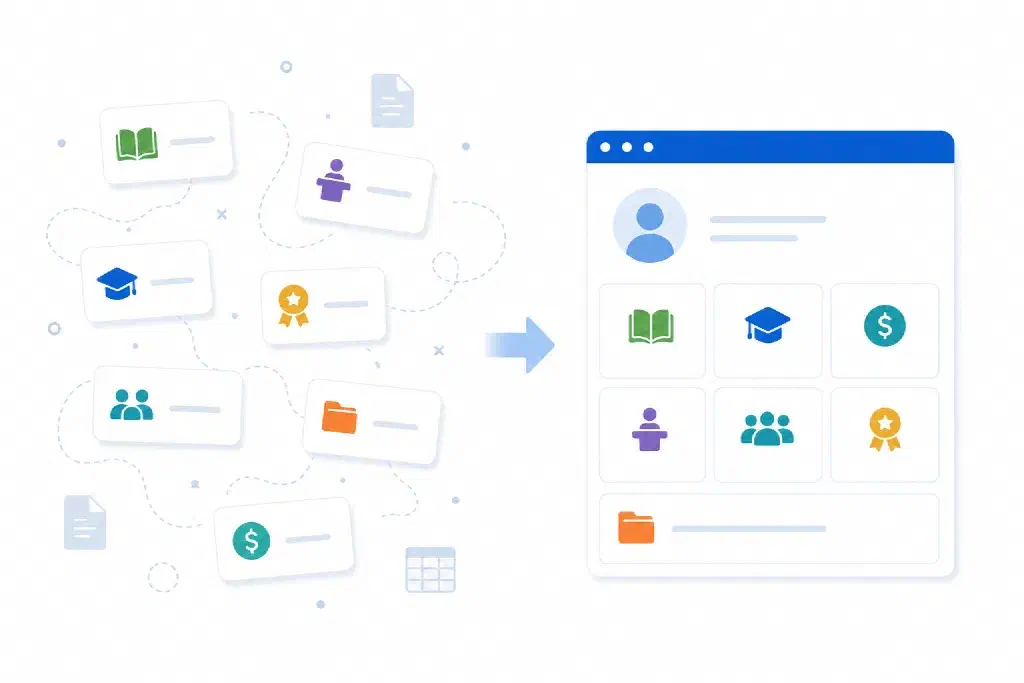
Faculty members do much more than teach classes. They conduct research, participate in service activities, advise students, serve on committees, attend conferences, publish scholarly work, and contribute to their institutions in many other ways.
Keeping track of all of those activities can be difficult for colleges and universities.
Faculty activity reporting software gives institutions a centralized way to collect, organize, and report on faculty activities.
Instead of relying on spreadsheets, email, paper forms, and disconnected records, institutions can give faculty and administrators a common system for maintaining faculty activity information.
What Is Faculty Activity Reporting?
Faculty activity reporting is the process of collecting information about the work faculty members perform for their institution and, in many cases, outside it.
The activities being reported can vary considerably by institution and discipline. They may include:
- Teaching activities
- Research and publications
- Presentations and conferences
- Professional development
- Community and institutional service
- Committee activities
- Student advising and mentoring
- Grants and other scholarly work
The purpose isn’t simply to create a list of everything a faculty member has done.
Institutions may use faculty activity information for annual reporting, faculty profiles, accreditation, institutional planning, workload discussions, and other administrative purposes. Learn more about what colleges and universities can use faculty activity data for.
What Does Faculty Activity Reporting Software Do?
Faculty activity reporting software provides a structured place for faculty members to enter and maintain their activities while giving administrators tools to collect, organize, and report on that information.
Depending on the system, this may include capabilities for:
- Collecting faculty activities
- Organizing activities into categories
- Generating reports
- Maintaining faculty profiles
- Supporting accreditation documentation
- Managing information across departments or programs
The important difference between software and a collection of spreadsheets is that the information can be maintained as an ongoing institutional resource rather than recreated whenever a report is needed. If your institution is still relying heavily on spreadsheets, learn why colleges are moving beyond spreadsheets for faculty activity reporting.
Why Do Institutions Use Faculty Activity Reporting Software?
Faculty activity information is often needed by many different people for many different purposes.
A department chair may need information about faculty activities for an annual review. An administrator may need a report for accreditation. A communications office may need information for a faculty profile. An institution may need to understand faculty contributions across teaching, research, and service.
When that information is maintained separately for each purpose, faculty and administrative staff can end up doing the same work repeatedly.
A centralized reporting system can reduce that duplication.
Faculty members can maintain their activities in one place, while authorized administrators can use that information to generate the reports they need.
Faculty Activity Reporting and Accreditation
Accreditation is one area where organized faculty activity information can be particularly valuable.
Accrediting organizations may require institutions to demonstrate that faculty have appropriate qualifications, remain professionally active, and contribute to the institution’s academic mission.
That can require institutions to gather information from many faculty members and organize it into documentation that supports an accreditation review.
Having faculty activities in a centralized system can make that process more manageable.
Rather than asking faculty members to recreate information whenever an accreditation report is needed, institutions can maintain the underlying information continuously and use it when reporting requirements arise.
What Should You Look for in Faculty Activity Reporting Software?
Not every faculty reporting system works the same way. When evaluating software, institutions should consider whether it fits the way their faculty and administrators actually work. Our guide to what higher education institutions should look for in faculty reporting software covers the most important capabilities to consider.
Easy Faculty Data Entry
Faculty members should be able to enter and update their activities without an unnecessarily complicated process.
If maintaining information is difficult, faculty participation can become a significant obstacle to keeping records current.
Flexible Activity Categories
Different disciplines have different types of faculty activities.
A useful system should be able to accommodate the activities that matter to the institution rather than forcing every department into exactly the same structure.
Useful Reporting
The value of collecting faculty activity information comes from being able to use it.
Look for reporting tools that can turn the information collected from faculty into reports that administrators can actually use.
Support for Accreditation
If accreditation reporting is an important part of your institution’s workflow, consider how the software can help organize and retrieve the information needed for accreditation documentation.
Faculty Activity Reporting Should Be an Ongoing Process
The most useful faculty activity reporting systems don’t treat reporting as a once-a-year administrative exercise.
Faculty activities happen throughout the year.
When faculty members can maintain their information as those activities occur, institutions can build a more complete and current record of faculty contributions.
That makes the information useful for more than a single annual report.
Faculty activity reporting software can give institutions a more organized way to collect faculty activities, generate reports, maintain faculty profiles, and support accreditation.
Faculty Atlas provides a straightforward way for institutions to collect faculty activities, generate reports, maintain faculty profiles, and support accreditation. Explore Faculty Atlas features to learn more about how the platform handles faculty activities, reporting, profiles, and accreditation support.